Why Choose a Bambach Saddle Seat Chair?
Table of contents
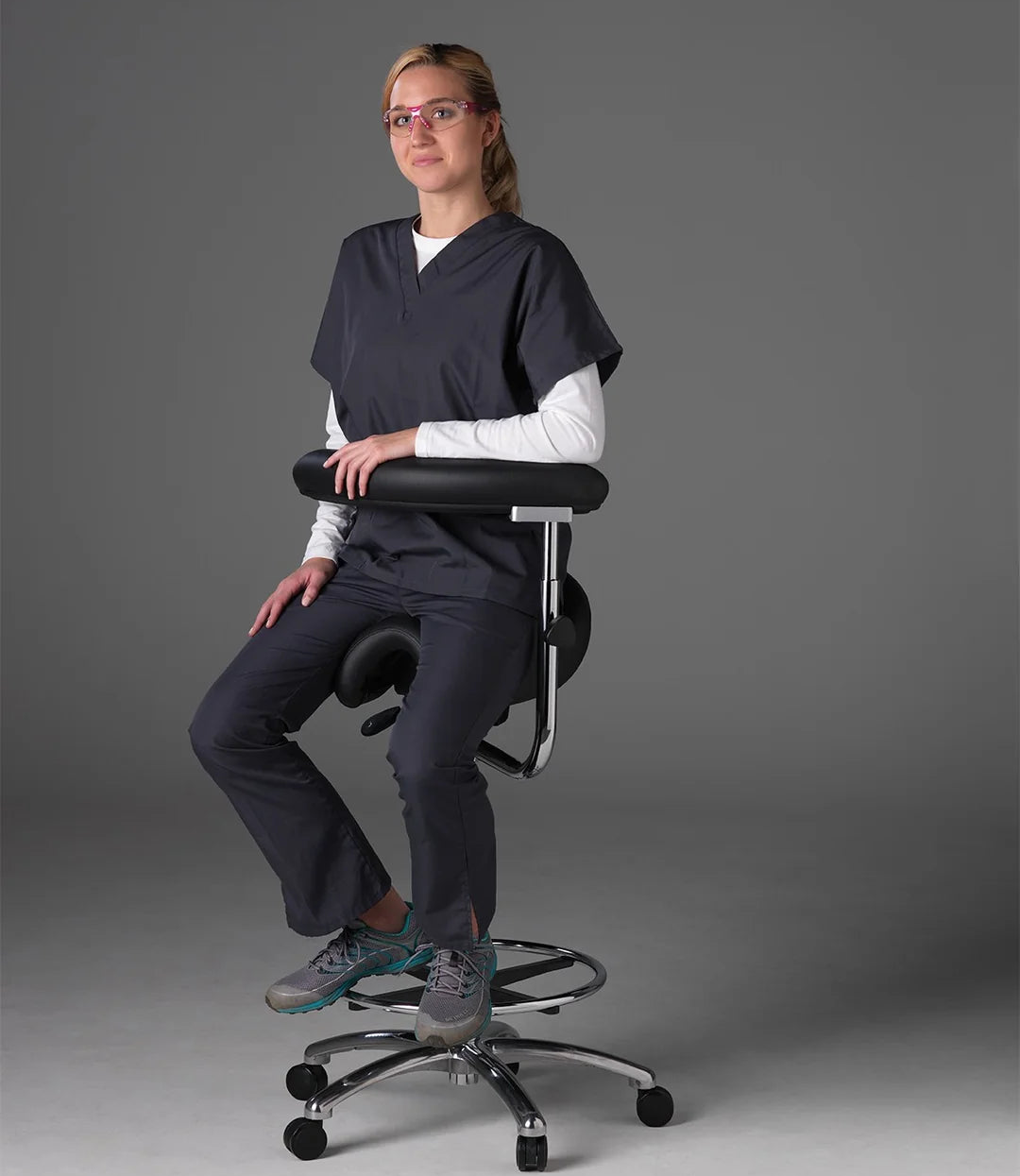
If your current chair leaves you leaning toward your work, sliding to the edge of the seat, or struggling to get close enough, more padding may not solve the problem. You may need a different sitting position.
A Bambach saddle chair places your legs to either side of a contoured seat instead of straight out in front of you. For people who work close to patients, equipment, desks, or benches, that change can make it easier to approach the task. The chair still needs to fit your body and workstation, but its design offers a useful alternative to a conventional office chair.
The Bambach sitting position
On a flat chair, your thighs usually extend forward and your hips remain relatively closed. The Bambach Saddle Seat lets your thighs angle downward and outward, creating a more open position between your torso and legs. Its contoured shape supports you in that position while you work.
You will generally sit higher on a saddle chair. That can help you reach work at an elevated surface and move closer without your knees getting in the way. It can also make it easier to turn between tasks or move around equipment. These benefits depend on having enough space beneath the work surface and a seat height that lets you feel stable.
The aim is not to hold a rigid posture all day. It is to start from a position that lets you work without repeatedly stretching, sliding forward, or folding over the task.
Close work and movement
A Bambach saddle chair makes particular sense when you need close access to detailed work. Dental and healthcare professionals may need to move around a patient. Veterinarians, technicians, artists, and other specialists may need to approach a bench or piece of equipment from different angles.
It can also work in an office, especially with a height-adjustable desk. Consider the chair if you regularly notice one or more of these problems:
-
Your knees or chair arms stop you from getting close to the work.
-
You lean forward for long periods to reach a patient, keyboard, or tool.
-
You need to move between nearby work areas while seated.
-
You use a foot control and need room to position your legs.
A chair cannot correct a desk that is too low, a monitor that is poorly placed, or tools that sit beyond comfortable reach. Look at the chair and workstation together.
Professions that use Bambach chairs
A Bambach saddle chair is intended for people whose work involves close, precise tasks or frequent movement around a work area. Common users include:
-
Dentists, hygienists, and dental assistants who need to work close to a patient, reach instruments, and sometimes use foot controls.
-
Healthcare professionals such as clinicians, sonographers, and therapists who move between a patient and nearby equipment.
-
Veterinarians and veterinary technicians who need flexible seating for examinations and procedures.
-
Artists, technicians, and laboratory workers who do detailed work at a bench, easel, or other raised surface.
-
Office and home workers who want a more open sitting position and have a workstation that can accommodate the chair’s height.
Your job title alone does not determine whether the Bambach Saddle Seat will suit you. The better question is whether its position helps you get close to your work, move as needed, and stay comfortable at your particular workstation.
Seat sizes and backrest options
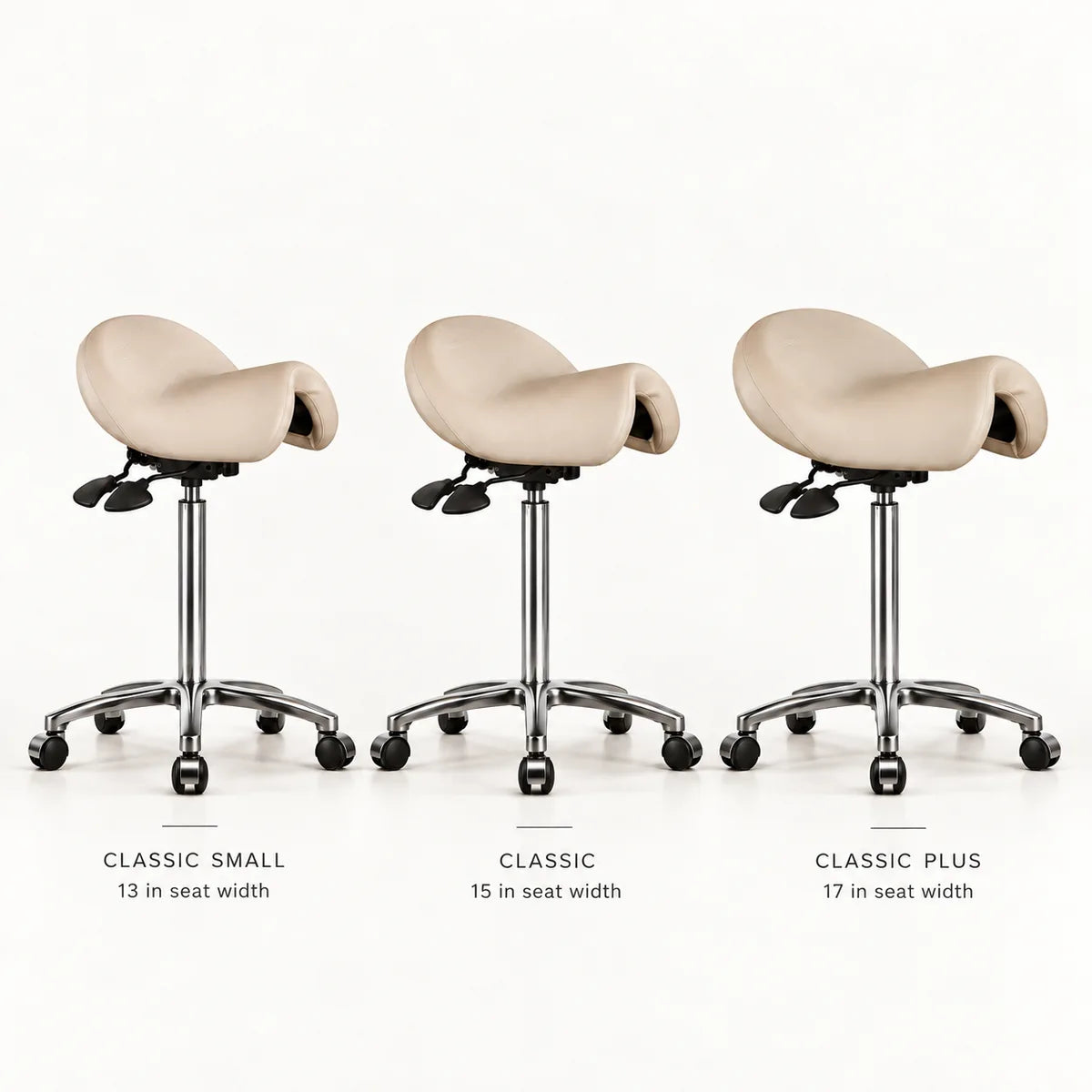
A generic saddle stool may offer the basic straddle position, but the Bambach gives you several choices that affect fit. Its seat is available in three sizes: Classic (15 inches), Classic Plus (17 inches), and Classic Small (13 inches). Cylinder heights and backrest options let you configure the chair for different bodies and tasks.
Those choices matter because a saddle seat can feel very different when its size or height is wrong. A larger seat is not automatically right for a taller person, and a smaller seat is not automatically right for a shorter one. Seat size determines how the saddle supports you; cylinder height determines where you sit relative to the floor and your work.
A backrest is another practical choice. It may give you a place to lean during conversations or less active tasks. A backless configuration leaves more room around the chair when you frequently turn and move. Neither is universally better—choose according to the work you do.
Fitting your Bambach saddle chair
Before choosing a Bambach saddle seat, measure the height of your desk, bench, or treatment surface and check the lowest obstruction beneath it. A drawer or keyboard tray can block your thighs even when the main work surface seems high enough.
Then consider your feet. At your working height, they should rest securely on the floor or on an appropriate foot support. If you use foot controls, check that you can reach and operate them comfortably. Your floor surface and the space available for the chair’s base also matter.
When trying the chair, adjust one setting at a time and perform a task you actually do. Check whether you can sit into the saddle, approach the work without raising your shoulders, move freely, and stand up without fighting the chair. A few minutes of sitting still will tell you less than working at your usual station.
Workstation compatibility
A Bambach is worth considering when it helps you get close to your work, keep your feet stable, and move without constantly leaning or reaching. It may be less suitable if you work at a low fixed desk with little leg clearance or need a chair you can recline in for extended periods.
Start with the problem you want the chair to solve. Then choose the seat size, height, and backrest around your body and workstation. That gives you a much better basis for buying than choosing from a product photo or a promise of “perfect posture.”
Frequently asked questions
Is a Bambach saddle chair only for dentists?
No. Dental work is a common use because it requires close access to patients and equipment, but the chair can also suit clinical, veterinary, studio, bench, and office work. The deciding factor is whether its seated position helps with your particular tasks.
Can I use a Bambach saddle chair at a regular desk?
Possibly. Check the desk height and the clearance beneath it before ordering. Because you generally sit higher on a saddle chair, a low fixed desk or an obstructive keyboard tray may make it difficult to position your legs and arms comfortably. An adjustable desk gives you more flexibility.
Which Bambach Saddle Seat size should I choose?
The options are Classic, Classic Plus, and Classic Small. Choose based on how the saddle fits and supports your body rather than height alone. Seat size and cylinder height are separate decisions; the right seat can still feel wrong if it places you too high or too low for your work.
Do I need a backrest?
That depends on how you use the chair. A backrest may be helpful when you pause or sit back between active tasks. If you need to turn frequently or move close to equipment, you may prefer the extra space of a backless chair. A backrest should not be used to compensate for a seat or height that does not fit.
How long does it take to get used to a saddle seat?
There is no single adjustment period for everyone. The position may feel unfamiliar if you are used to a flat office chair, so begin with properly adjusted sessions at your actual workstation and pay attention to pressure and comfort. If discomfort persists or increases, check the fit rather than assuming you simply need more time.
More articles
Why Bambach Saddle Chairs Work So Well for Dentists
October 2, 2026
How to Adjust Your Bambach Saddle Chair
September 29, 2026