Bambach Saddle Chair vs. Office Chair: Which Fits Your Work?
Table of contents
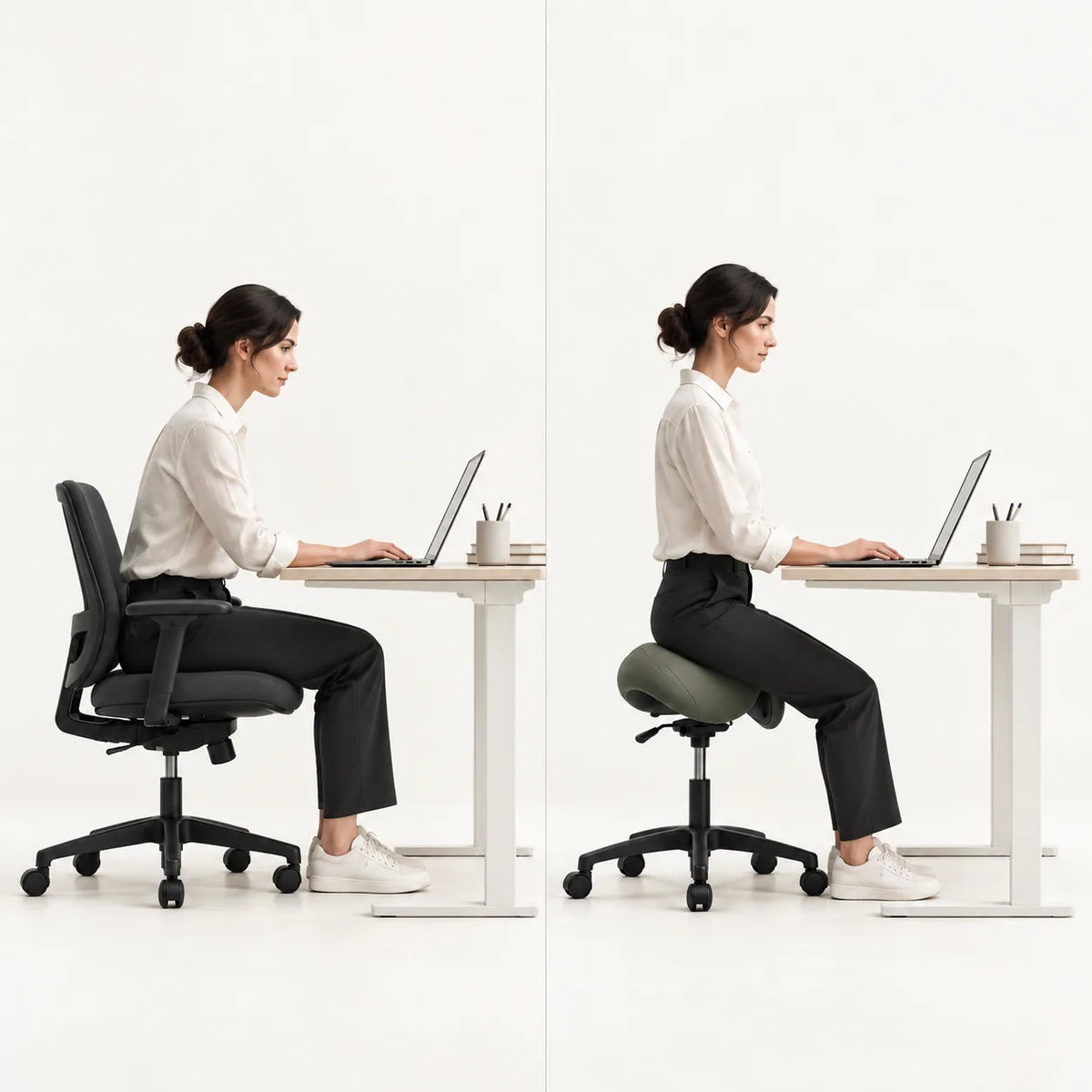
A traditional office chair and a Bambach saddle chair can both be used at a workstation, but they change how you approach the work. An office chair gives you a broad seat, a backrest, and often armrests or a reclining position. A Bambach places you on a contoured saddle seat with your legs angled downward to either side.
That difference matters when your day involves more than sitting in one place. If you move around a patient, work at a bench, reach toward detailed equipment, or regularly slide to the front of your office chair to get close enough, the Bambach may give you a better starting position. If you spend most of your time sitting back at a fixed desk, an office chair may fit your routine more naturally.
The choice comes down to your tasks, your workstation, and how each chair feels while you actually work.
The sitting position
On a conventional office chair, your thighs generally extend forward from a flat seat. The backrest and, on some models, the armrests help support you in that position. You can sit upright in a well-adjusted office chair, but its shape still places more of the chair and your legs between you and the task in front of you.
The Bambach Saddle Seat supports a more open position between your torso and thighs. Its saddle shape lets your legs angle down and out rather than straight forward. You usually sit higher, with your upper body positioned above the work rather than leaning out from the back of a deep chair.
You do not need to think about a particular hip angle or hold yourself rigidly upright. The practical test is whether the position lets you approach your work comfortably, keep your feet stable, and move without repeatedly sliding or stretching to reach.
Getting closer to the work
Close access is one of the clearest reasons to consider a Bambach saddle chair. In an office chair, your knees may meet the desk before your hands reach a comfortable position. Armrests can catch on the work surface, while a deep seat can leave you sitting farther from a patient, instrument, or workpiece than you want.
The Bambach’s compact saddle leaves more space around your legs. Instead of sitting back and reaching forward, you can bring your seated position nearer to the task. That can make a noticeable difference in dentistry, healthcare, veterinary work, and detailed bench or studio work.
Office chairs vary, and an adjustable model may let you move its armrests or change its seat position. Still, if you repeatedly perch on the front edge of your chair to do your actual work, it is worth comparing that experience with sitting properly on a saddle seat.
Working from a higher position
A Bambach generally places you higher than a traditional office chair. At a treatment surface or raised bench, that position may help you see the task and approach it without bending so far forward. It can also change where your arms rest relative to the work.
The higher position only helps when the surrounding setup matches it. If a desk is too low, you may end up lowering the Bambach until the advantage of the saddle position is lost. A drawer or keyboard tray can also restrict your thighs even when the desktop itself appears high enough.
Before choosing a chair, look at the height of the work surface and the clear space beneath it. At the height you need for your hands and eyes, your feet should also feel securely supported. A height-adjustable desk offers more flexibility, but a fixed desk can work if its dimensions suit your seated position.
Movement through the workday
Most people do not sit perfectly still while working. You turn toward a nearby surface, move in for a closer look, stand to retrieve something, and return to the task. In clinical or technical work, you may need to change your position several times while working on the same patient or project.
A Bambach works well with that kind of movement. Its compact shape leaves less chair surrounding you, making it easier to rotate, roll a short distance, stand, and sit again. You can move the whole chair toward a new angle rather than repeatedly leaning or twisting out of a stationary position.
An office chair may be more comfortable for tasks where you remain in one place and use its backrest or armrests for support. Neither pattern describes an entire profession. Think about how often you move during your own workday and whether your current chair helps you follow the task or gets in the way.
Back support and fit
A backrest is one advantage many people value in an office chair, particularly for reading, calls, and less active computer work. Choosing a Bambach does not require giving that up. Bambach saddle chairs are available with or without a backrest, so you can decide whether you want a place to lean during pauses or a more open area around the chair.
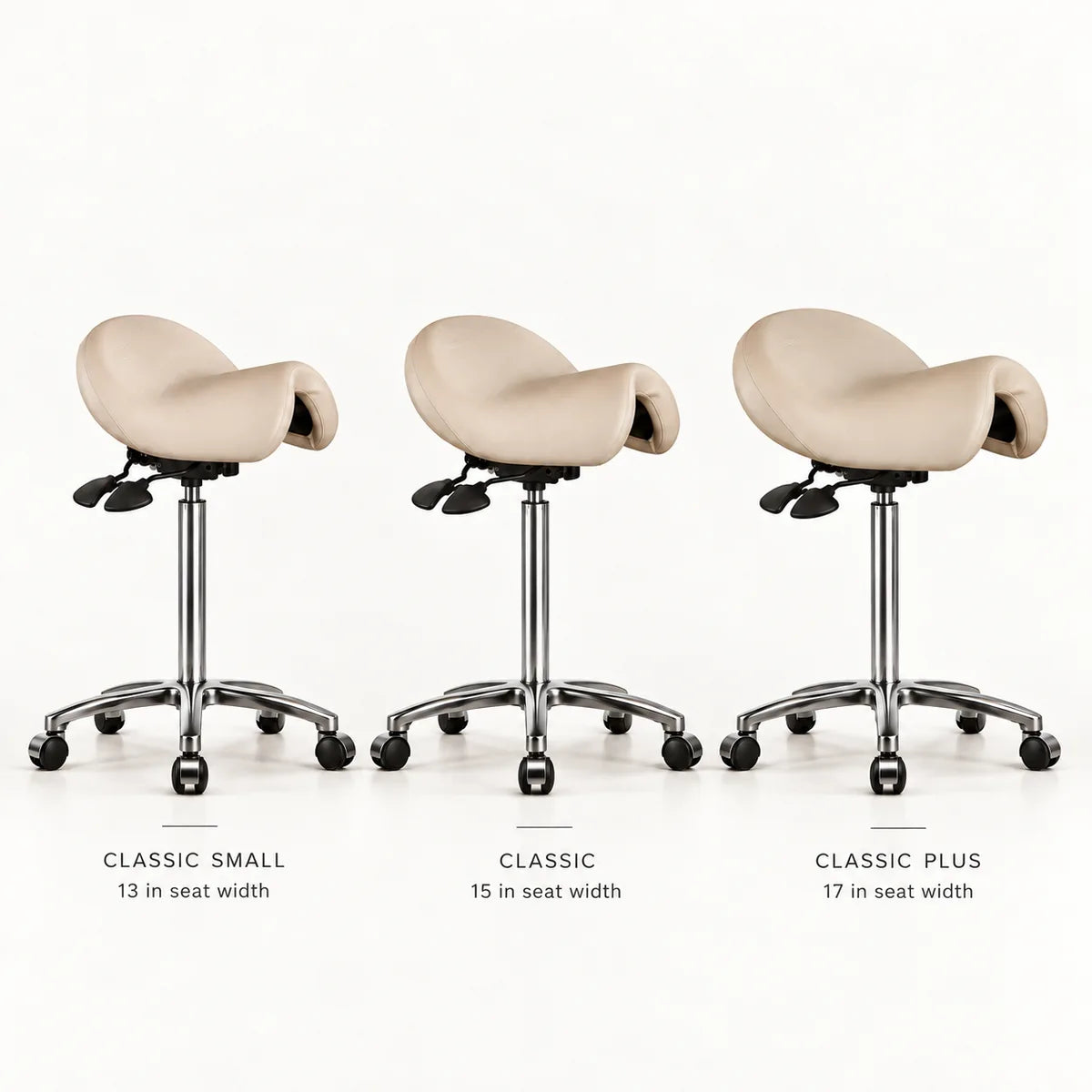
The seat itself also needs to fit. Bambach offers three sizes: Classic Small at 13 inches wide, Classic at 15 inches, and Classic Plus at 17 inches. Short, medium, and tall cylinder choices provide different working-height ranges, while the seat has height and tilt adjustment.
These choices serve separate purposes. Seat size affects how the saddle supports your body; cylinder height determines where you can position yourself relative to the floor and your work. A backrest addresses how you want support between or during tasks. Choosing a larger seat or taller cylinder simply because you are tall may not produce the best fit.
Office chairs have their own adjustments, including seat height, depth, backrest position, and armrest placement on many models. Compare what you can adjust on each chair against what you actually need. An impressive list of features matters less than being able to reach your work comfortably.
Desk and computer work
The Bambach is not limited to clinical or hands-on settings. You can use it for typing, mouse work, and other computer tasks if the desk and chair are set up together. The main difference from an office chair is that the saddle position often puts you higher and changes how your legs fit beneath the desk.
Start by setting the chair where the saddle supports you comfortably and your feet feel stable. Then check whether the keyboard, mouse, and screen can be positioned for work without raised shoulders or a long forward reach. Avoid dropping the chair to an uncomfortable height merely to get your knees under a low desk.
A conventional office chair may be the simpler choice at a fixed, low workstation, especially if you rely on its armrests or sit back for extended periods. With a suitable work surface, the Bambach offers a more active alternative for someone who moves between computer work and nearby hands-on tasks.
Where the Bambach stands out
The Bambach has the strongest practical appeal when the chair needs to follow your work. It is worth a close look if you need:
-
Closer access to a patient, workpiece, or surface without the front of a deep chair or its armrests getting in the way.
-
A higher working position that suits an elevated surface and lets you see detailed work comfortably.
-
Room around your legs as you turn, approach equipment, or reposition.
-
Easy movement between nearby tasks rather than working from one fixed seated position.
-
Fit choices in seat size, cylinder height, and backrest configuration.
These are reasons to try the Bambach, not promises that it will suit everyone. Its advantages are most useful when its size, height, and surrounding workstation are right for you.
Comparing both chairs yourself
A first impression from sitting still will not tell you enough. If you have access to both chair types, compare them while performing the same tasks at a suitable working height. Spend time approaching the work, using your hands, turning to nearby items, and standing up and sitting down again.
Pay attention to a few specific questions:
-
Can you get close enough without sliding to the edge of the seat or leaning far forward?
-
Do your knees, the chair’s armrests, or the desk structure limit your position?
-
Can you reach the task without lifting your shoulders?
-
Do your feet feel stable at the height where you work best?
-
Can you change angles by moving the chair, or do you have to twist out of it?
-
Are you comfortable during both active work and quieter seated tasks?
Try the chairs at the workstation you intend to use, if possible. The same Bambach saddle seat may feel useful at a raised treatment surface and poorly matched to a low fixed desk. Your actual tasks will reveal more than a product photograph or a few minutes of sitting.
Choosing for your work
A Bambach saddle chair is a strong option when you need close access, a higher working position, and freedom to move around the task. A conventional office chair may suit work centered on a fixed desk, particularly when you value a broad seat, arm support, or reclining between tasks.
Your day may include both. Focus on the work you do most often and the problem you want the chair to solve. If the Bambach’s position helps with that work, the next step is choosing the right seat size and cylinder height for your body and workstation.
Frequently asked questions
What changes most when switching from an office chair to a Bambach?
The seat shape changes where your legs sit relative to your work. On the Bambach, your thighs angle downward and outward, and you generally sit higher. The useful difference is whether that position lets you approach your tasks and move more comfortably.
Do office-chair armrests help or hinder close-up work?
They can do either. Armrests may support your arms during computer work, but they may also hit a desk or prevent you from getting close to a patient or workpiece. Try your usual task with the armrests in their normal position before deciding whether they help.
When might an office chair be the better choice?
An office chair may suit a largely stationary workday, especially if you often sit back to read or take calls, use its armrests, or work at a low fixed desk. The Bambach’s advantages matter most when close access and movement are important to your tasks.
Can I use both chairs during the same workday?
Yes. You may prefer the Bambach for active, close work and an office chair for quieter seated tasks. Check your keyboard, work surface, and screen positions when switching; the same setup may not suit both sitting heights.
Will switching to a Bambach change my keyboard and monitor setup?
It may. Because you often sit higher, check that your hands can reach the keyboard without raising your shoulders and that the screen is comfortable to view. Changing the chair without checking the rest of the workstation can leave the original reaching problem unresolved.
How should I test the two chairs before choosing?
Perform the same real task in each chair at an appropriate working height. Compare how close you can get, whether you need to lean or twist, how easily you change position, and whether your feet remain stable. Spend enough time working to judge more than the first impression.
More articles
Why Bambach Saddle Chairs Work So Well for Dentists
October 2, 2026
How to Adjust Your Bambach Saddle Chair
September 29, 2026